By Adam Goedken
Read time: ~20 minutes
Where's my refund? | Fair enough (to vote for?) | What college is good for | How we got here | How much college could be free college if college could be free? | The rational debate (finally) | TL; DR
Where’s my refund?
A few weeks ago, I watched politics Twitter get riled up over a video from an Elizabeth Warren campaign event in Grimes, Iowa. You can watch the exchange here (48:35).
In the clip, a man approaches Warren during a Q&A, saying, “My daughter’s getting out of school, I’ve saved all my money, she doesn’t have any student loans.”
“God bless her,” says Warren.
The man cuts to the point. “Am I going to get my money back?”—a reference to Warren’s plan for “universal free public college and cancelling student loan debt for 42 million Americans”.
Warren replies without hesitation. “Of course not.” Direct!
There are many arguments against student-debt-forgiveness plans, but the Grimes man’s is one of the most emotional. “So, you’re going to pay for people who didn’t save any money, and those of us who did the right thing get screwed.” It’s my own knee-jerk reaction, as a current public-university student myself: any free-college/debt-erasing program could arrive just-too late for me. Is my generation the last to graduate with college debt? That doesn’t seem fair! So, I empathize with the man in the video.
That man is just one of many who oppose programs like Warren’s along less political, more personal lines—people who are upset they won’t receive direct benefits, because they’ve already paid for college. Let’s call a typical member of this group an “aw-man voter”—as in, “Aw man, I just paid for that thing that’s free now”. I feel for these people!
But Warren’s response to aw-man-voters everywhere is valid too: whatever your opinion of her plan, it’s unlikely that you believe the U.S. should refund every single person who ever paid for college. “Okay,” I tell myself, after a strong—but cheap! (again, I’m a college student)—cup of coffee: “If I oppose free college solely because college was not free for me, then I’m not really taking a rational stance.”
A Twitter user persuasively (if bluntly) argued that point in the Warren video’s comments with a sarcastic illustration:
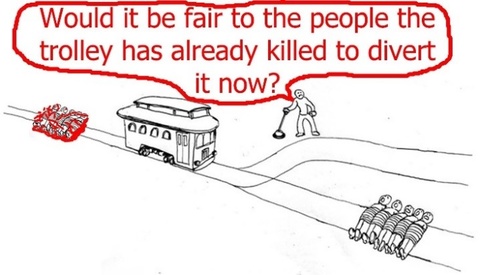
Under Bernie Sanders’ plan, which, unlike Warren’s, cancels all student-loan debt regardless of borrowers’ household income, those unbloodied folks tied to the tracks would be spared from $1.6 trillion in student loan debt, while the government would pay at least $79 billion yearly to erase tuition at public colleges. Taxpayers and college grads certainly have the right to be concerned about those large numbers—that’s where the debate should be. They shouldn’t be concerned about the unchangeable past—the poor, unsavable souls behind the trolley. But will voters cast their ballots based on sunk costs anyway?
Fair enough (to vote for?)
Here’s a classic sunk-cost example: Back in December, one of my friends paid $12 to see Cats, and about 15 minutes in, he realized his mistake (Cats is bad), but the movie still had another 71 minutes of run-time, so he gritted his teeth and suffered quietly in his DreamLounger™ until the credits rolled.
My friend did exactly what I would’ve done, but his behavior doesn’t make much sense to economists, who believe that, in general, people act in their own self-interest. My friend paid $12, which lowered his happiness, let’s say, 12 points, expecting to see a movie that would give him 12 points or more of happiness. During the movie, as it became clear that his happiness level would only continue to fall, he should’ve walked out of the theater and skipped rocks, or something—should’ve done anything that would’ve made him happier than watching the rest of Cats. Rational people should constantly make in-the-moment decisions to maximize their level of happiness.
But people act counter to their own self-interest all the time. While student-loan forgiveness or free-college-for all could help only college students at the expense of others (Betsy DeVos says, “It's going to be two of the three Americans that aren't going to college paying for the one out of three that do”), it’s possible that everyone might benefit from such programs. Some believers in Warren’s and Sanders’ plans say that the indirect financial benefits any voter would receive could outweigh an accompanying tax-hike.[1] These supporters may or may not be right—but even if those positive results could be guaranteed, I still find it unlikely that aw-man voters will vote for Elizabeth Warren.
One reason why an aw-man voter probably won’t vote for Warren could be the same reason that my friend sat through the entirety of Cats: Aw-Man has already “paid the price” for the current higher-education financing system, and now that system feels like something that must continue, perhaps to justify Aw-Man’s purchase, or maybe because that’s just what we do.
I brought this idea to University of Iowa economics professor, Sarah Frank, who agreed that this kind of sunk-cost fallacy could play a role in my imagined aw-man voter’s decision-making; but, she said, the decision to vote in an election is fundamentally different from the decision to watch a movie: when you vote, your choice impacts yourself and others.
Professor Frank suggested a more likely explanation for why an aw-man voter might oppose student-debt forgiveness: sometimes people don’t act in their own self-interest because a significant portion of their happiness, or utility, is based on what happens to other people. That idea may seem obvious or straightforward, but (relatively speaking) it’s a new idea in economics (with origins in the ‘80s), termed “social preferences”.
Professor Frank gave me a crash course in social preferences with a couple examples:
- People often make decisions that hurt their own financial well-being to help others. How do economists explain that altruism? Helping others increases your happiness. A pure example is donating to charity: you give $1,000 to charity (-1,000 points of utility, for simplicity) but you become 3,000 points happier, because the world is better to live in when others suffer less. That’s a net 2,000-point increase in utility.
- But people will also occasionally sacrifice financially to hurt other people, especially when they feel like some injustice has been committed. If X worked hard and followed the rules, but X senses that Y is about to cut the line or cheat, X may spend $100 to hurt Y in order to gain more than 100-points-worth of utility from a sense of justice.
Perhaps aw-man voters will perceive direct beneficiaries of government-run college-payment programs as benefitting unfairly, and they will sacrifice potential spillover economic benefits to maintain a sense of fairness.[2]
Of course, this whole conversation about “sacrificing benefits” hinges on the assumption that:
- A college education benefits more than just the person who receives it.
But what if that isn’t true? It’s a strong assumption if it has no logic argument to back it up. So, is college good for all? Or, what is college good for?
What college is good for

Maybe my older sisters stacked the deck?)

Professor Solow used the example of a large employer nearby the University of Iowa to explain: “It’s really good for Collins Aerospace to have people that have a positive disposition toward Eastern Iowa as part of the labor force.” If there’s no university in Iowa to regularly feed qualified workers to Collins Aerospace, does Collins Aerospace (and many local businesses that Collins workers patronize) exist in Iowa in the first place? It seems unlikely—and that’s another reason states fund universities: colleges’ effects align with the goals of government, fueling the economy and benefitting communities.[3]
But, says Professor Solow, “governments today don’t acknowledge (spillover benefits of colleges) to the degree they used to”. There’s been a shift of costs to students as state governments decrease public-school funding. This shift may be attributable to a Game-of-Life attitude that “whoever gets the benefit should pay for it”, which seems to fail to acknowledge that students are not the only ones who receive the benefits of college.
At the same time, though, maybe that Game-of Life attitude is justified! It’s clear that the income gap between college graduates and non-grads is widening. College is still a good deal, says Economics for Inclusive Prosperity (ECONFIP), if you can pay for it in the first place and finish your degree: “The economic return to a college degree is still near an all-time high of around 14 percent per year – double the long-term return on stocks” (and, crucially, more than interest rates on student loans). Meanwhile, the inflation-adjusted paychecks of workers with only high school degrees have shrunk. So, not everyone in society seems to be feeling the spillover effects of colleges—and therefore, maybe not everyone should pay for colleges—especially if graduates can afford to foot the bill.
On the flipside, maybe that income gap exists because non-college-educated workers are in lower demand: our Information Age, automation-happy, globalized American economy demands more college grads in the workforce as it shifts away from the need for human inputs in manufacturing and toward the need for services workers. Perhaps the supply of workers without college degrees is greater today than it should be (which suppresses wages for that group)—or would be if college were more attainable to all. Again, ECONFIP: “college is both increasingly necessary and increasingly unaffordable”.
Why college grads get paid more doesn’t just boil down simply to supply and demand, though. The common view is that higher education increases “human capital”, and workers get paid more for that gain in ability. College, in theory, transforms its attendees into more-productive members of the labor force.
But perhaps, say some economists, more-productive workers are born, not made. Jane Doe is particularly apt at learning to build bridges—but when she applies for Bridge Inc., there’s no way for employers to distinguish between the bridge-building capacities of Jane and her twin brother and fellow applicant, John. John is very bad (dangerously bad!) at learning to build bridges.
JANE’S BRIDGE

JOHN’S BRIDGE

So, Jane goes to college to get an engineering degree that “signals” to Bridge Inc. that she is a better candidate—she passes her tests because she is good at learning about bridges. John, meanwhile, tries to get an engineering degree, but he gets no merit-based scholarships, and he can’t work a job during school because he spends all his time fruitlessly studying, and engineering school becomes too expensive for him to finish. When the twins apply for work, Bridge, Inc. sees that one candidate has a degree and the other doesn’t, and the company hires Jane. Perhaps John goes to music school instead, because it is a more natural fit for him.
JOHN’S COMPOSITION

JANE’S COMPOSITION

In this theory, college is a sorter of workers, not an improve-r of workers.
Which theory is true? As one research paper title pithily asks, “Does education raise productivity, or just reflect it?” The question has implications central to the free-college and debt-forgiveness debate:
- If college does raise human capital, society should attempt to make the individual cost of university to any student as low as possible, to raise the output (and consumption) of the entire economy.
- If college is just a signal, then society would want the individual cost of university to be higher, to efficiently sort the students who can afford it (with their natural skills) from those who can’t;[4] making college more affordable would drive wages down as employers become less certain of applicants’ viability, and fewer productive workers would find jobs that compensated them for their worth.
I asked Professor Frank whether she believed college is a signal or builder of human capital, and she said most economists probably believe it’s a half-and-half mixture of the two. So, perhaps unsurprisingly, the waters are muddy on what the individual cost of college should be.
If there are valid arguments on both sides, then, what is the point of laying out this information—from split-levels to spillovers to signals?
It’s this: beliefs on both sides about what college is good for are the main drivers of the debate over how to fix the college-payment problem.
And there at least seems to be a consensus that there is a problem: that $1.6 trillion dollar student debt figure is ominous in any context you look at it—personal, political, or economic. My friend, Zach Fischels, a CFP, shared his perspective with me: “student loans are holding a ton of young people I meet with back from starting investing and building wealth…” Bloomberg.com frames rising student debt as a dangerous factor increasing consumer default risk:
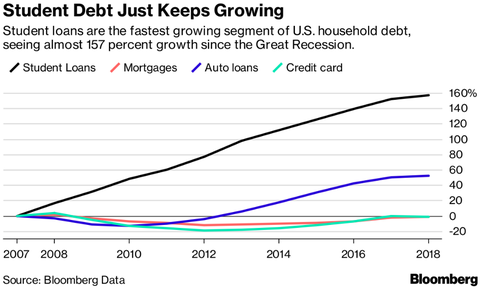
We’ve all seen alarming graphs like this one before. A lot of them have x-axes that begin around the 2008 recession—it’s around there that many trace the origins of the current student-debt crisis. How that crisis is understood—and misunderstood—explains how we arrived at the current political conversation around free college.
How we got here
The Chronicle reported the saga: Dunleavy justified his decision by saying the state universities were a poor return citizens’ investment, with “low graduation and retention rates”, too much money spent on high-salary administrators, and redundancies between the three public universities in the state (such as multiple schools for the arts). The government would divest from the schools and encourage them to act more like private institutions. A state official working for the governor said, “There’s nothing wrong with encouraging a university to diversify its revenue stream”.
The public colleges unsurprisingly found plenty wrong with that idea! The Chronicle quoted their reaction to the funding cuts: “The board has to decide whether its house is on fire or whether it’s just toast burning,” (Alaska public university system president James) Johnsen told the regents. “In my view,” he added, “our house is on fire.”

The governor suggested that the universities cut research funding, which the board of regents’ chairman rejected, saying: “We’re not going to run bake sales”(!) to keep vital research for the state (including urgent studies on fisheries or climate change) running.
The university system and the governor eventually came to a deal that significantly lessened the funding cuts, but the University of Alaska will likely have to become a single-location school. Clearly, not everyone was pleased with the outcome: “‘I think the regents, in the position they’re at, had a gun to their head and basically agreed to the words that were on the page,’ (Democratic Sen. Scott Kawasaki) said.”
Whoo boy. That’s a dramatic story—there’s two well-defined opponents; the consequences are clear. It’s a rare, Alaska-specific case, where a lot of Alaskans give scathing quotes to reporters. But it’s indicative of something that’s happened more quietly across the rest of the country over the last decade: state governments, which have a lot of power over state universities, want less financial responsibility for their bulky, expensive public colleges. They cite arguments that universities act like poorly-run, inefficient businesses.
Those arguments really aren’t wrong on their face. Public universities can look like bottomless pits that governments throw money into. Of course, they aren’t—(if you’ll allow me to briefly repeat myself,) they have large, positive, indirect impacts on states. But as traditional businesses, they suck! If someone like Governor Dunleavy did a cost-benefit analysis of a public-school investment, and the only benefit he considered was the cold-hard-cash revenues that the school generated, then the bottom line certainly wouldn’t look like it justified the state’s investment.
So, he looks at a different business model for universities—private college—and says, ‘that seems to work fine without the state’s help’ and he tells the University of Alaska, ‘go find other revenue sources’ and he withholds the university’s funding to set a fire under their rear.
It’s easy to paint the governor as someone who doesn’t care about college, or who wants to spite a liberal university, or who doesn’t need college-aged voters to get himself reelected (all of which could be true; I don’t know). But he could also be making a good-faith effort to improve Alaska’s school system based on a misunderstanding of what public colleges are good for—or based on a misguided belief that public colleges serve the same purpose as private colleges.
But public schools and private schools serve different markets.[5] Crucially, state-run schools provide an alternative opportunity to students for whom access to private college is unattainable. Those cheaper schools have lower per-student resources—yet they’re still viewed as a good investment if they maintain a certain level of credibility and quality.
If states disinvest in public schools, those schools must take measures to survive—they must find new funds to maintain quality. So, they begin operating more like private colleges: they raise tuition rates, or they increase their promotional spending. The attractiveness (and original purpose) of the state-run option begins to be obscured. Statehouses across the country have made similar (if less dramatic) efforts like Alaska’s to “improve” state schools since the Great Recession that began in 2008.
University of Michigan professor Susan Dynarski says that states began squeezing their pocketbooks out of necessity during the Great Recession, and public colleges took an especially strong hit: they were foundationally long-termist institutions during a time when states needed short-term financial relief.
But states didn’t loosen their budgetary grip like you’d expect after the economy recovered. The graph below from the Center on Budget and Policy Priorities (CBPP) shows how the post-recession cutback in state funding for higher education was 1) widespread across the country; 2) severe in some places; and 3) long lasting (this graph is from 2017).
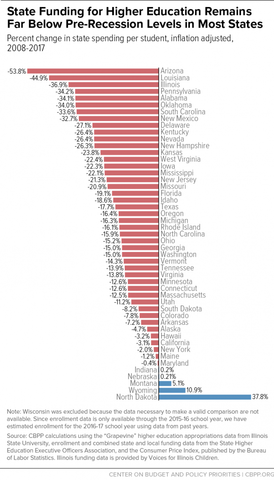
Rebekah Tilley, Communications and Social Media Specialist at the University of Iowa, wrote an in-depth article about how the University of Iowa has dealt with lower funding from the state.[6] “State appropriations are the university’s most volatile source of income,” she writes; the college can’t decrease spending without lowering quality and losing enrollment (a death spiral for universities), but funding has decreased—something’s gotta give.
In the article, then-Dean of Iowa’s business college, Sarah Gardial, describes a shift in the university’s resource-allocation model—now, “you eat what you catch”: the educational departments that bring in more student revenue (through tuition and higher enrollment) receive more resources. Perhaps this shift has made the college more competitive and internally efficient; however, it’s not enough to fully counteract the loss in funding. The university needs more revenue.
They could raise revenue by running a bake sale, or maybe by raising enrollment. But higher enrollment means higher total spending as well. Additionally, another consequence of the Great Recession was that birth-rates declined, so there’s a shrinking supply of students for colleges to recruit. So, alternatively, the University of Iowa seeks out students who will pay more—like out-of-state and international students.
If those measures aren’t enough (and they often aren’t), the board of regents raises tuition. The University of Iowa is not the only institution facing these pressures (I met with Tilley, and she told me that in fact, Iowa has been more successful than most at keeping tuition low); across the country, states bear less and less of the cost of college, and students bear more.
So, how do the examples of Alaska and Iowa relate to current perceptions of who’s to blame for student debt?
Well, first off, no one wanted tuitions to rise—some might view the actions of Alaska’s governor as an intentionally malicious attack on students, but that’s probably not fair—he was likely trying to make the school system more efficient (though his methods were ill-advised). Others might have thought tuition hikes at the University of Iowa were a selfish money-grab by the university (I certainly did, when my tuition increased), but universities often raise tuition as a last resort in response to decreased funding. Finally, some might blame students nowadays for being financially irresponsible, but today, they carry more of the financial burden of college than generations past. Everyone is simply responding to financial pressures.
Those responses led to the debt crisis. Dynarski does a great job explaining the cause-and-effect chain of events that led to how we got here.
She explains first that “the typical debt that’s in default is about $5,000”. Most student debts are “small debts” from for-profit or two-year schools. That was surprising to me—I’d assumed most debt was from private school or graduate school, but Dynarski refutes that: graduate students or ivy-leaguers with big debts are “very unlikely to default on their student loans”; they can pay off their debts with high-paying post-grad jobs. “So, the problem is not among those who graduate from elite institutions, no matter how many videos you see of them on presidential campaign websites”, she says.
Note that it’s not those attending four-year public colleges who are feeling the most pain, either—the defunding of those four-year institutions more greatly affects attendees of two-year community college or for-profit colleges (according to Dynarski, 80% of undergraduates go to public college, and 50% of undergraduates touch community college).
Here’s how Dynarski explains the chain-reaction:
- When states take away money from public colleges, tuition rates at public colleges rise. That pushes students to community colleges, either for a two-year degree or to begin a four-year degree.

- Community colleges are “open access”, meaning they can’t restrict who enrolls (they can only run waitlists), so they begin overfilling; they are “overflowing…overwhelmed”.
- Facing long waitlists for classes, would-be public-community-collegegoers head to for-profit colleges instead. When students are forced out of community college, they are charged prices at for-profit institutions “that look more like Harvard” and they must take on debt.
- While community colleges are generally a “good deal” for students, for-profit colleges are not (they have, on average, a 0% return). When graduates of those institutions enter the workforce (especially during a bad labor market), they are unlikely to get a good-enough return on their education to pay off their loans. So, they default.
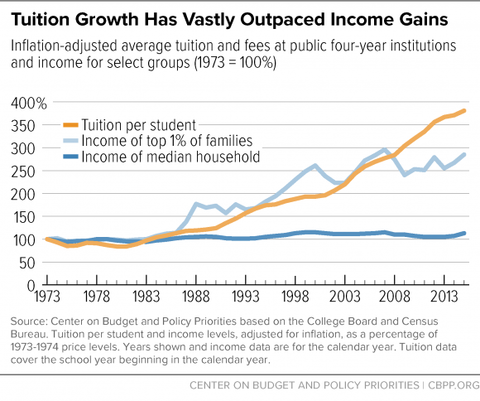
(Someone at the CBPP makes very nice graphs!)
Fueling the crisis, federal student-aid policy has shifted over time from grants to more loans. Dynarski describes the shift as an “intergenerational transfer”: a large group of people who went through college and got good schooling funded by high taxes later led a “tax revolt” that hurt collegegoers thereafter.
So, that’s the problem free-college-for-all and student-debt-cancelling are meant to address. Debt-cancelling is meant to stop the bleeding and free-college is meant to stitch up the wound.
But some voters who agree with the intent of the plans might disagree about their implementation. What would free college or debt-forgiveness look like (they wonder), and how would they address the root causes and worst effects of the student debt crisis?
In other words…
How much college could be free college if college could be free?
I mean, I’ll start with this: what does free college mean for colleges?[7]
It’s something I talked with Professor Solow about. He says, “separate the question of funding college vs. setting the price of college equal to zero”. In other words, you could think of two possible extreme ways that college could be made free:
- The federal government completely pays for all public college tuition.
or
- Public colleges are no longer allowed to charge any tuition.
Both ways have a lot of problems! Here’s a problem apiece:
- If the federal government pays for all tuition, then colleges will set through-the-roof prices for tuition—free money!—and the program will fail.
- If colleges stop charging tuition, but everything else remains the same, then colleges lose their main revenue stream, and they pretty much cease to exist.[8]
And tuition is not the only reason college is so expensive! Students must pay living expenses, like food (for me, that means a lot of Jack’s pizzas) and rent; those expenses can surpass yearly tuition rates. Funding from the federal government direct to universities wouldn’t cover those kinds of expenses.[9]
But anyway, somewhere between the extremes 1) and 2) is a middle ground that free-college supporters probably advocate for. And there has to be some implementation that works (regardless of how well it works), because free college already exists in the world; plenty of countries have it: Sweden, Germany, the Czech Republic, Denmark, Norway, Finland, France, New York.
Those locations are much smaller (in population and geography) than the United States, and they have fewer public colleges: Germany and France have the most, with around 300 and 100 respectively, but the rest have under 30 public colleges apiece. In New York, free college tuition is restricted to families making under $100,000 yearly—it’s not free college “for all”.
There are 1,626 public universities in the United States, and their governance is hardly centralized; the federal government currently has control over financial aid and accreditation, but not over direct funding or spending decisions at public colleges. Costs that different colleges face might vary greatly from location-to-location; a college in Washington, D.C. probably faces much higher costs for real estate than a college in Wyoming. It might not be so easy for the United States to make big, central decisions at the federal level that perfectly suit all the idiosyncratic universities scattered across the land.
So, making college free for all in the Unites States would be a unique challenge—America likely wouldn’t find much success by exactly mimicking what other countries have already done. But that’s not to say it wouldn’t necessarily be a worthwhile challenge. What should the goals of an American free-college system be? ECONFIP tries to lay out some “design principles” that such a system might aspire to:
- “Increase college access”—the policy should aim to give students the most education per dollar spent. This one’s obvious. The whole reason these proposals exist in the first place is to make college cheaper for students.
- “Focus on the supply side”—“demand-side subsidies” like Pell Grants are meant to make colleges compete for students, but higher education in practice isn’t very competitive (besides elite private colleges). Supply-side support, in the form of direct funding to universities, could do a better job preventing the death-spiral that Tilley described, where resources per student decline, quality declines, and completion rates drop.
- “Federal funding should flow directly to institutions, but with strings attached”—the “strings attached” are to prevent colleges from jacking up tuition when the federal government pays for it.[10] The government will have to monitor where its funds go to make sure universities are using them to increase total spending as enrollment increases, not to increase tuition.
Both Sanders’ and Warren’s free-college-for-all[11] plans track with these design principles (of course, any proposal in practice would be subject to change through the legislative process). But no matter how fleshed-out any free-college plan is, there’ll still be plenty of potential problems to speculate about.
The plans include provisions that states must “maintain spending” in order to receive federal funds. It’s worth asking what “maintain spending” means—if “spending” in this case is not inflation-adjusted spending per student, then education quality could suffer, or money could flow away from important research. I also wonder: would colleges in states that currently don’t fund their universities enough continue to suffer (if the federal government contributes to those universities based on current funding levels), or would state-schools with current high tuition rates get perversely rewarded with more funding?
My intuition is that many of these questions have already been raised, and the creators of free-college-for-all plans would be working to answer them. But it’s unlikely that any new system will be perfect—the important question is: would it be better than our current (certainly imperfect) system of paying for college?
The answer you find most credible might depend on how you estimate the potential effectiveness of the federal government, or how much you believe in a given candidate, or how equitable you perceive the potential effects of the plans to be, or how convincing you find alternative college-payment solutions. Between all these perspectives, there are real arguments, there’s a real debate over what’s the right thing to do.
These arguments are less instinctual, less reactionary: they’re rational, and when it comes to college-payment policies, these rational arguments are what citizens should care about the most.
The rational debate (finally)
Pete Buttigieg publicly opposes Warren’s and Sanders’ plans on the grounds that they will “subsidize the children of millionaires and billionaires”. Even if the plans are funded by increased taxes on the wealthiest Americans, the Economist says: “A universal college benefit would disproportionately help families that are already comfortable” by citing that most college-goers are well-off already. The same article argues that racial and wealth inequalities in college attendance might be due to the “quality of earlier schooling”. “For that reason, universal pre-kindergarten may be a more effective use of resources than universal free college.”
There is a legitimate fear that the plans will disrupt a system that is already as fair as possible. If public colleges are free, then will degrees from those institutions carry less value?[12] If so, then perhaps students who are more financially prepared to attend private school will avoid the less-valuable public schools that lower-income students will mostly attend.
Supporters of free-college-for-all of course push back against these ideas. Warren and Sanders argue that college education should be considered citizens’ right (the way K-12 education is now); therefore, income shouldn’t determine whether it is available to someone. And they’d probably push back against the argument that college students are typically more well-off: ECONFIP argues that “Making college free could shift many more poor students into college in the first place”.[13]
Other arguments about the viability of free-college-for-all and debt-forgiveness programs center on how they will be paid for. According to the New York Times, free college and debt-forgiveness might cost less than most people think: tuition at state schools is already low (on average under $10,000 for 4-year public schools), so the federal government’s bill won’t be so bad. And, they say, more graduates with higher lifetime earnings prospects means, over time, the government will collect more tax revenue. The Los Angeles Times refutes those claims, saying grants would be a more cost-efficient way to support higher education, and a free-college program could increase the federal budget deficit if the government underestimates its cost.[14]
Finally, there are a whole host of alternative ideas for how to solve the current college-payment problem. I’ll list out a few.
Perhaps making just 2-year community college free is a better idea. The NEA points to Tennessee, where just such a system exists. However, ECONFIP argues that 2-year programs might decrease 4-year degree attainment, which might not be ideal. If such a system existed, the government might need to spend a lot of money if they’re to solve the problem Dynarski laid out: community colleges would need more funding for more resources to meet higher demand and to prevent overflow into for-profit colleges.
Besides expanding grants, the government could also provide interest-free loans instead of free college. That approach would help slow or halt student-debt default. Students might still be left paying higher and higher tuition rates, however, and free-college supporters might make the argument that students shouldn’t need to pay out-of-pocket for college on principle. (“Principle? We’re just asking for the principal!” say no-interest advocates.)
Lastly, some say the government should just do a better job informing young people—particularly low-income students—of the financial aid resources available to them. Part of this alternative solution might include simplifying the federal aid formulas so that students can more easily identify what they qualify for.[15] Or, perhaps, as Zach Fischels pointed out to me, students would benefit from receiving more information about their post-grad income prospects before they make the decision to take out loans.
Professor Frank told me about one program that successfully combines informing young people with financial support to put more low-income students through college: 21st Century Scholars in Indiana. The program pays up to four years of participants’ college tuition. All Indiana students who maintain a GPA above 2.5 and who qualify for free-and-reduced lunch can join the program in junior high. The program includes “step-by-step guidance and support” to increase participants’ chances of eventually completing college. Interestingly, after the program began, Indiana’s high school dropout rate fell—perhaps knowing that college was a possibility encouraged participants to stay in school. A national program like 21st Century Scholars could be an alternative way to solve inequality in higher education. At the same time, this kind of program also doesn’t address all the contributors to the debt crisis as described by Dynarski.
Regardless of how you view these alternatives, it’s clearly a false choice that “you’re either for free-college-for-all and student-debt forgiveness, or you’re against any plan to make college more affordable or equitable”.
It’s up to individual voters to decide if there’s a problem with our current college-payment system that’s worth solving, and if so, how we should go about fixing it.
TL; DR
Thanks for reading, and let me know your thoughts/opinions by commenting on this article!
[1] For example, Aw-Man’s net happiness could rise when other peoples’ debts are forgiven, because Aw-Man’s employer raises wages—more than the additional taxes Aw-Man pays—to attract more workers, because the company needs more workers to keep up with increased consumer demand from millennials who are no longer scrimping and saving to pay off their loans. Other supporters of the plans say that the financial benefits may not outweigh the costs in taxes, but that the happiness of living in a country with more equitable opportunities would outweigh the decrease in happiness accompanying higher taxes.
[2] Professor Frank pointed out that there’s also a different kind of voter who may sacrifice to prevent others from receiving debt-forgiveness: someone who perceives debt-accumulation as a moral failing. There are some who believe that those who don’t pay what they owe are cheaters: debt-forgiveness would violate those folks’ sense of justice. For people of means, this moral position can seem perfectly reasonable; but evidence shows that most Americans who can’t pay off their loans don’t have out-of-control spending habits—they were pushed into debt paying for medical emergencies or basic necessities like groceries, and they never had time to build up savings.
[3] While that fact doesn’t necessarily imply public schools should be free for all, it is a talking point among supporters of free-college plans. The National Education Association (NEA) makes the case that colleges have outsize benefits on communities in their argument for free public college: “New spending on public colleges…produces more economic activity than a similar-sized tax cut…And, over their lives, college graduates…commit fewer crimes, draw less on social welfare programs, and generate more taxes”.
[4] This explanation, is of course, oversimplified for the sake of argument. It ignores the high barriers to entry that less-privileged would-be college-goers face when applying for university (which could include test-taking fees, college-visit travel costs, or less-accessible financial-aid/application information) as well as the many non-merit-based advantages students from wealthy families might enjoy (e.g., lowered entry requirements for children of university donors). Someone who believes college is a signal could reasonably say that the current system of college payment doesn’t allow for efficient sorting in the first place, because its design is unfair—in which case, society might prefer free college or debt-forgiveness.
[5] Private universities generally have the reputation of having smaller classes, providing more attention to individual students, providing fancier food in the dining halls. Students seeking college educations who want that more personalized experience and who are willing to pay for it attend private schools. Students who are either unable, unwilling, or uninterested to pay for private college attend public college, or they go to community college for two-year programs. According to University of Michigan professor Susan Dynarski (in a video by the Stanford Center on Poverty and Inequality), disadvantaged students typically attend public colleges.
[6] Tilley begins the article: “Maybe if Iowa had kept its old World War II-era Quonset hut classrooms and skipped the rec center with climbing walls, college would be more affordable, right? Not really. And here’s why…”
[7] Dear debt-forgiveness,
I haven’t forgotten about you. It’s just that, when it comes to questions of implementation, you’re straightforward; you’re not all that interesting to me (it’s not you, it’s me!). The government will pay for you, one time, straight up (with tax revenue). It’s unclear if banks will be mad about losing a steady stream of student-loan interest revenue, but otherwise, we know what you’ll look like. Hope we’re cool.
-Adam
[8] Except for maybe large-endowment universities, like Harvard. Harvard can probably afford to keep the lights on for another thousand years.
[9] Warren’s free-college plan includes an expansion of Pell Grant funding to cover the non-tuition costs of college for those who need it—basically, it considers the problem of paying for food and rent. Even that might not be the perfect solution; you could ask: if a public-college town suddenly saw increase in the typical student population size (because of free college), would there be a student-housing shortage? Would those Pell Grants go as far as they used to if living costs rise? Might this solution be the best one available anyway?
[10] Alternatively, without spending rules, nefarious colleges could hold tuition constant, but lower spending per student, thereby “capturing” the increase in funding for themselves. Tricky!
[11] Other democratic candidates generally advocate for expanding Pell Grants and other aid, but not for eliminating student tuition. Buttigieg advocates for free college for low-to-middle-income students (though wealth might be a more important factor determining whether families can pay for college)—but for the purposes of this article (paper? blog?) I’ll just lay out the free-college-for-all plans.
[12] This idea hearkens back to the theory that college is a “signal” to employers.
[13] If Jane didn’t want to take on debt, or she didn’t think that she could afford college (because she didn’t know about scholarships/aid/loans available to her), maybe she wouldn’t have considered going to college an option for her at all. When college becomes free, maybe Jane finally considers it.
[14] While we’re talking about big costs, it’s worth noting another argument against free college and debt-forgiveness: some small-government advocates might oppose these plans because they see any new social program as making the federal government larger and more powerful.
[15] Professor Frank points out that simplifying the aid formulas would make them match students’ financial situations less perfectly, and thus make federal financial aid less efficient in general; however, she says, perhaps that’s a worthwhile tradeoff if more students are aware of their potential financial support.